Two Hundred People, a Thousand Stories: The Living Memory of Dunbeath
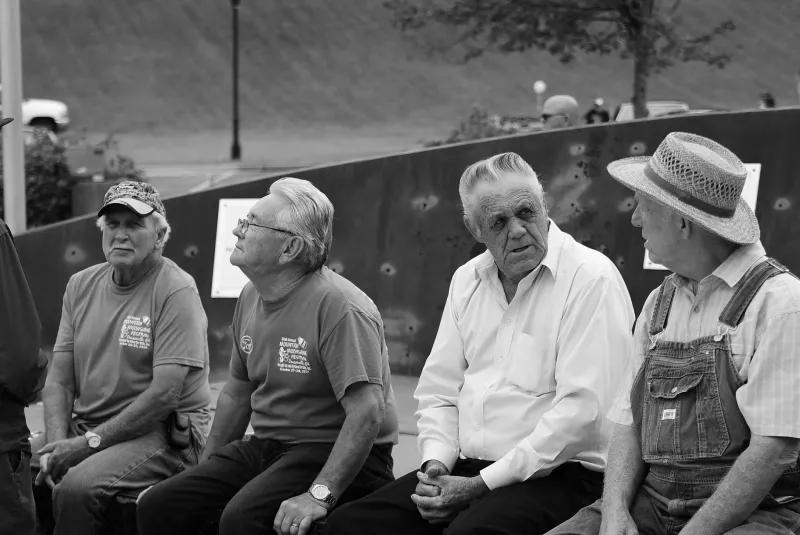
Neil Gunn, Dunbeath's most celebrated son, understood something about small communities that takes outsiders a while to grasp. The stories that matter most in a place like this are never the ones in the books. They're the ones passed between people who already know half the context — told in shorthand, interrupted by laughter, corrected by someone who was actually there.
Dunbeath has roughly two hundred permanent residents. That's a number small enough that most people know most other people, at least by sight. It's also a number that creates a very specific kind of social ecosystem — one in which information, memory, and narrative circulate in ways that are entirely unlike anything you'd experience in a town or city.
Visitors who notice this, and who approach it with genuine curiosity rather than romantic projection, often describe it as one of the most striking things about the place. Not the landscape (though that's extraordinary), not the heritage (though that's rich), but the simple, living fact of a community that has found ways to carry its own history forward through conversation.
How Stories Travel in a Small Place
In urban life, we tend to think of knowledge as something that exists in systems. Databases. Search engines. Official records. When we want to know something, we look it up. The information is stored externally, retrieved on demand, and largely disconnected from the person who first knew it.
In Dunbeath, knowledge is stored in people. And because people interact constantly in a community this size, that knowledge moves — gets updated, disputed, added to, recontextualised. A story told at a kitchen table in January might come back in a different form at a harbour wall in July, carrying new details that someone else contributed in the meantime.
This isn't the telephone game, where things get garbled and distorted. It's more like a living document — one that gets revised through use, that incorporates new evidence, and that is collectively owned rather than belonging to any single narrator.
The oral historian Jan Vansina spent decades studying exactly this kind of knowledge transmission in other contexts, and his findings suggest that communities with strong oral traditions can maintain accurate historical memory across remarkable spans of time. Dunbeath's community doesn't need academic validation to know this. They just know it, because they live it.
The Informal Gathering Places
Every small community has its unofficial nodes — the places where people reliably meet, linger, and talk. In Dunbeath, these shift slightly with the seasons and the time of day, but they're consistent enough that a visitor who pays attention will start to recognise them.
The harbour is an obvious one. It's a working space as well as a scenic one, and working spaces generate conversation in a way that purely scenic spaces don't. People who are doing things talk differently to people who are looking at things. The talk at the harbour tends to be practical, specific, and full of references that require local knowledge to decode — which is precisely what makes it worth listening to, even when you can only catch the edges of it.
Shops, as we've noted elsewhere on this site, carry their own conversational weight. So do the roads themselves — in a village this small, stopping to exchange a few words with someone you've passed is normal rather than unusual. Don't be surprised if what begins as a brief hello extends into something considerably longer and more interesting.
And then there are the less visible gathering points: the places where people sit for a few minutes between tasks, the spots where the path widens enough for two people to stand comfortably. These aren't marked anywhere. You find them by being around long enough to notice where people tend to pause.
What Visitors Can Respectfully Do
It's worth being direct about this, because the temptation to romanticise Highland community life is strong and the reality is more nuanced. Dunbeath's residents are not a living museum. They're not performing their culture for visitors, and they're not obligated to share their stories with anyone who asks.
What they are, in the main, is hospitable — in the particular Highland way that combines warmth with a certain reserve, that takes time to open up, and that responds far better to genuine interest than to performative enthusiasm.
If you want to participate in or witness the conversational life of the village, the approach is simple: be present without being demanding. Sit somewhere for longer than you planned to. Let conversations start naturally rather than engineering them. Ask questions that come from real curiosity rather than from a checklist of things you want to know. And if someone tells you something interesting, don't immediately reach for your phone to record it — that changes the nature of the exchange entirely.
The stories that find their way to visitors in Dunbeath are usually the ones that were going to be told anyway. You just have to be in the right place, at the right moment, with the right kind of attention.
The Gunn Connection
It would be impossible to write about Dunbeath's storytelling culture without acknowledging what Neil Gunn did with it. His novels — particularly Highland River and Morning Tide — are essentially attempts to capture in literary form the texture of the community he grew up in. The way memory works in those books, the way the past is always present in the landscape and in the people, reflects something real about how life in Dunbeath actually functions.
Visitors who have read Gunn before arriving often report a strange doubling experience — recognising things in the actual village that they encountered first in the fiction. That's not because the novels are documentary, but because Gunn understood the deep structure of the place well enough to render it truthfully.
The Dunbeath Heritage Centre holds material that connects the literary legacy to the living community, and it's worth visiting — not just to learn about Gunn, but to understand the relationship between the stories a place tells about itself and the stories that actually circulate within it.
Why This Matters Beyond Dunbeath
There's a reason this kind of community knowledge feels remarkable to most visitors, and it's not a comfortable reason. We've largely destroyed it elsewhere. The combination of mobility, digital communication, and the decline of shared physical spaces has dismantled the oral knowledge networks that sustained communities for millennia. We've replaced them with things that are more efficient and less alive.
Dunbeath hasn't escaped modernity — nobody has. But its size and its geography have helped it maintain something that most of Britain has lost: a genuine living memory, carried in people rather than servers, revised through conversation rather than algorithm, and shared freely with anyone patient enough to listen.
That's not a small thing. That might, in fact, be the most important thing Dunbeath has to offer.