Close Your Eyes in Dunbeath: A Sound Journey from First Light to Dusk
We are, most of us, overwhelmingly visual travellers. We photograph, we frame, we seek out viewpoints. The camera roll fills up; the ears go largely ignored. But there's a strong argument that the most honest record of any place isn't a photograph at all — it's a sound. Sounds are harder to stage, harder to filter, and far more effective at bypassing the rational mind and landing directly in memory.
Dunbeath has one of the most distinctive soundscapes on the Scottish coast. Here's how to experience it — from the first pale light over the firth to the last of the evening settling in.
Before the Village Wakes: Dawn at the Harbour
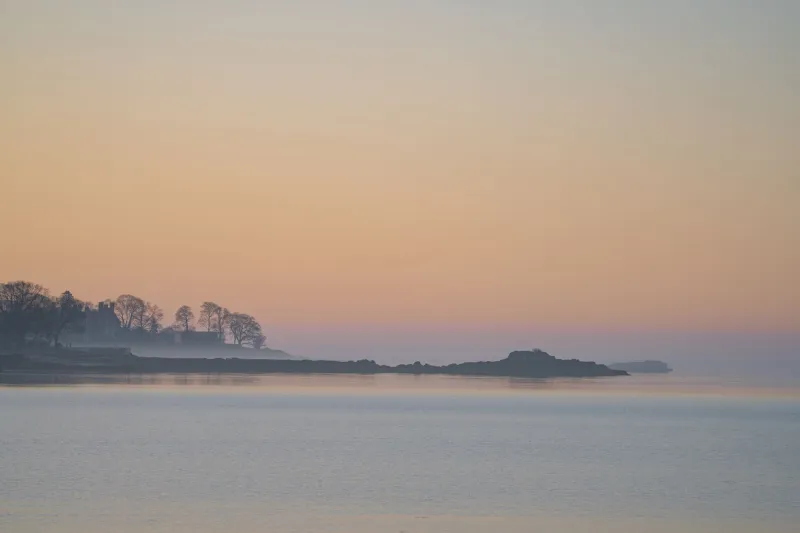
If you can manage it — and it takes genuine commitment, particularly in winter — arrive at Dunbeath harbour before sunrise. The car park sits right at the water's edge, and in those pre-dawn minutes, with the sky still indigo and the first suggestion of light appearing over the North Sea, the acoustic world is extraordinary.
The dominant sound is water. Not the dramatic crash of a storm coast but something more conversational — the harbour water moving against stone, a low rhythmic slap and withdrawal that feels almost like breathing. Beneath it, the creak of mooring ropes under tension, the occasional metallic knock of a hull against a fender. The boats are talking quietly to themselves.
Then, usually before you've had time to properly settle, the birds begin. Dunbeath's dawn chorus isn't the lush, layered affair you'd hear in a woodland — this is a coastal version, sparser and sharper. The first calls are often from oystercatchers: that insistent, piping kleep-kleep that carries extraordinary distances across still water. Herring gulls follow, their cries shifting from the mournful to the almost aggressive as the light grows. Occasionally, if the tide is right, you'll hear the guttural churring of a cormorant somewhere along the harbour wall.
This is the best possible beginning to a day in Dunbeath. Bring a flask of something warm and simply listen.
Mid-Morning: The Strath in Full Voice
As the morning progresses and you head inland along the Dunbeath Strath — that long, green river valley that cuts away from the village into the hills — the soundscape transforms completely.
The sea recedes. In its place: the Dunbeath Water itself, which has an entirely different character from the harbour. Here the river talks constantly, its sound shifting with every bend and rock — quickening to a chatter over shallows, deepening to a low rumble where the channel narrows. Walking slowly alongside it, you start to notice that the river is never actually silent; it just changes register.
The strath amplifies certain sounds and absorbs others. Wind that would be aggressive on the coast becomes a softer presence here, filtered through gorse and birch. In spring and early summer, the calls of curlew carry across the upper slopes — one of the most emotionally affecting sounds in the British countryside, a long descending whistle that manages to sound simultaneously mournful and completely at ease. If you're lucky, and quiet enough, you might also catch the rapid, bubbling song of a dipper from somewhere near the water's edge.
Best listening spot: The old stone footbridge about a mile up the strath. Stand in the middle of it for five minutes without moving. The river sound below, the wind in the vegetation on either bank, and the birds above create a kind of accidental three-dimensional audio that's genuinely difficult to leave.
Lunchtime: The Village at Work
Return to the village around midday and the soundscape has shifted again. Dunbeath in the middle of the day has a quiet industriousness to it that's easy to miss if you're not paying attention.
There's the distant percussion of someone working on a boat engine — a sound that carries from the harbour in a series of irregular thumps and pauses. A door closes somewhere up the hill. A quad bike moves along a track above the village, its pitch rising and falling with the gradient. These are the sounds of a community going about its actual business, and they're worth attending to precisely because they're not performed for you.
On still days, voices carry further than you'd expect. A conversation on someone's doorstep, the particular cadence of a Caithness accent — flatter and more Scandinavian in influence than the Highland voices further west — drifts across the street. It's not intrusive; it's simply present, a reminder that you're in a living place.
Recommended stop: Sit on the low wall near the harbour and eat your lunch without your phone. Give it twenty minutes. You'll be surprised what you start to hear.
Afternoon: Wind and Weather
Dunbeath's afternoon soundscape is largely written by the weather. On a calm day, the village settles into a deep quiet that has almost physical weight — the kind of silence that people who live in cities find either blissful or slightly unnerving. On a windy day, the whole character of the place changes.
The wind off the North Sea has a particular quality here — not the low roar you might expect but something more complex, a sound that shifts pitch as it moves through the harbour structures, the cottage chimneys, the rigging of moored boats. It's possible to spend an entire afternoon simply listening to how the wind expresses itself differently across different surfaces. The whistle through a wire fence. The hollow boom against a garage door. The way it drops suddenly in a sheltered close and then picks up again at full volume the moment you step back into the open.
The sea itself, heard from the cliff path above the harbour, produces sounds that change with every swell. On a moderate sea, there's a continuous low hiss and drag from the rocks below — the water pulling back through shingle and then surging forward again. In rougher conditions, that becomes something altogether more dramatic: a deep, intermittent boom as waves meet cliff face, followed by the hiss of spray.
Best listening spot for wind: The path above the harbour looking north. Face into the wind, close your eyes, and hold that position for a few minutes. It is, in its way, a form of meditation.
Evening: The Village Settling Down
As the light drops and the day winds towards its close, Dunbeath undergoes one of its most beautiful acoustic transformations. The birds shift register — the daytime calls giving way to the quieter, more tentative sounds of birds finding roosts. The wind typically eases. The harbour water, caught in the last of the light, moves with a slower, heavier sound than it had at dawn.
From somewhere in the village, perhaps, comes the smell and faint sound of a fire being lit — the subtle crackle of wood catching, the shift in air quality that a chimney smoke creates. A television audible through a thin wall. A dog settling on a step.
Dunbeath in the evening sounds like rest. Like a place that has done what it needed to do today and is now, without fuss, becoming quiet.
That sound — unhurried, unperformed, entirely genuine — is worth travelling a long way to hear.