Don't Rush to Dunbeath: The Case for Making the Journey Your First Adventure
Photo: Unknown authorUnknown author or not provided, Public domain, via Wikimedia Commons
Don't Rush to Dunbeath: The Case for Making the Journey Your First Adventure
Somewhere around Pitlochry, something shifts. You can't quite name it at first — the traffic has thinned, the retail parks have given way to forestry, and the hills pressing in on either side of the road have a different quality to them. The journey to Dunbeath, done properly, begins long before you arrive. In fact, for a growing number of UK travellers, it begins the moment they decide not to fly.
There's a phrase doing the rounds in travel writing circles: slow travel. It's been gaining traction for a few years now, partly as a response to the frantic, box-ticking style of holiday that leaves people needing a holiday to recover from their holiday. The idea is straightforward — the journey isn't a inconvenient gap between home and destination, it's part of the experience itself. And few journeys in Britain make that case more powerfully than the long, unhurried road north through Scotland to the Caithness coast.
The Psychological Case for Going Slowly
There's genuine science behind the intuition that rushing to a place prevents you from fully arriving. Psychologists who study transitions — the mental shifts between different states of mind — have found that we need time and distance to properly leave one context behind and enter another. When we fly somewhere, or drive at motorway pace with podcasts drowning out the landscape, we arrive physically but not mentally. The work stress, the domestic noise, the low-level digital hum: it all comes with us.
The road to Dunbeath is long enough, and varied enough, to do the decompression work that a short journey can't. By the time you reach the Caithness plateau and the land opens out into that extraordinary flat vastness of bog and sky, you're already a different version of yourself than the one who left the house that morning. The Highland air, the slower pace of roads that simply don't permit hurrying, the gradual subtraction of urban clutter from the landscape — it all accumulates into something that feels, by the time you arrive, rather like relief.
The Drive: A Journey in Three Acts
For those coming by car from central Scotland, the journey to Dunbeath divides naturally into distinct phases, each with its own character.
The first stretch — Edinburgh or Glasgow northward through Perthshire — is familiar enough, the kind of driving that doesn't demand much. But pay attention as the road climbs into the Cairngorms. The scale changes. The sky gets bigger. The villages become further apart and the architecture more austere. This is Scotland beginning to mean business.
The second phase begins somewhere around Inverness, where the road north along the A9 — a road that has been improved considerably in recent years — starts to feel genuinely remote. The Cromarty Firth opens to the east; the Black Isle sits opposite; and the mountains that crowd the western horizon begin to feel less like scenery and more like a presence. Stop at Tain if you want a proper lunch. Walk down to the water at Dornoch. Let the day breathe a little.
The third and most dramatic phase begins as you cross into Sutherland and then into Caithness. The landscape performs one of the most startling visual transformations in Britain: the mountains simply stop, and you emerge onto a vast, wind-scoured plateau that feels like the top of the world. The sky dominates everything. The light is extraordinary — cleaner and more northern than anything you'll find further south. And then, after miles of this wide-open emptiness, the land drops suddenly to the sea, and there is Dunbeath below you, tucked into its valley, the harbour glinting in whatever light the day has decided to offer.
The arrival, after all of that, feels genuinely earned.
The Train: A Different Kind of Revelation
For those without a car, or those who simply prefer to let someone else do the steering, the rail journey north deserves its own chapter. The Far North Line — which runs from Inverness to Wick — is routinely described as one of the great train journeys of Europe, and that's not hyperbole. It passes through landscapes that most of Britain will never see: coastal inlets, ancient peatbogs, river valleys where you half expect to see wolves.
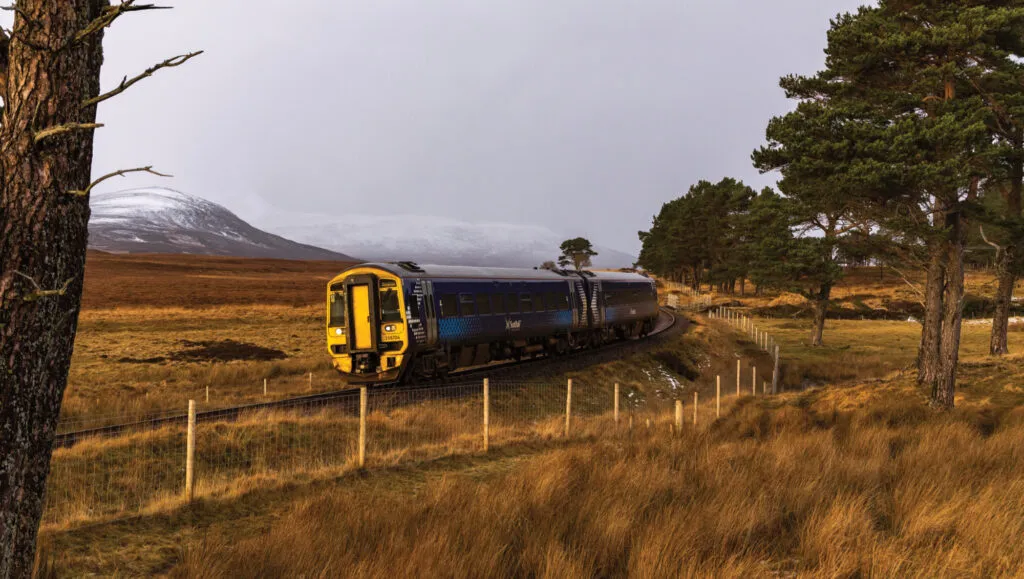 Photo: Far North Line, via transform.scot
The service is not fast. That's the point. The train stops at small stations that feel like they belong to a different century, and the pace of travel is slow enough that you can actually look at the landscape rather than watching it blur past. Bring a book, but don't feel obliged to open it. Some of the best thinking you'll do on this journey will happen while you're simply watching Scotland pass the window.
From Wick, a short bus or taxi journey south completes the approach to Dunbeath — and arriving by public transport, without a car, forces a kind of engagement with the place that driving can sometimes prevent. You walk more. You notice more. You arrive, in every meaningful sense, more fully.
What You're Actually Travelling Towards
Dunbeath is not a place that announces itself loudly. There are no signs pointing to famous attractions, no visitor centres visible from the road, no coach parks. What the village offers is something quieter and, for many people, considerably more valuable: a genuine sense of place, rooted in history, shaped by the sea, and largely undisturbed by the commercial apparatus of modern tourism.
That quality — the sense of arriving somewhere real — is earned partly by the village itself and partly by the journey that brings you there. A place this honest deserves an honest approach. The slow road north, whether by car or train, strips away the noise and the hurry that prevent most of us from properly experiencing somewhere new.
By the time you pull into Dunbeath, the journey has already done half the work. All that remains is to walk down to the harbour, watch the tide doing what it has always done, and realise that you've arrived somewhere genuinely worth the distance.
A Few Practical Notes for the Slow Traveller
If you're driving, the A9 is the natural route north, but the coastal road through Brora, Helmsdale and Berriedale is worth taking for at least part of the journey — it hugs the shore in ways the main road doesn't, and the views across the Moray Firth are something else entirely.
For train travellers, Scotrail's Far North Line timetable requires some planning — services are infrequent, so check times carefully before booking accommodation. The journey from Inverness to Wick takes around three and a half hours, which sounds long until you're on the train and wishing it would last a little longer.
Either way, resist the temptation to treat the journey as lost time. It isn't. It's the beginning of what Dunbeath will do to you.