Built to Last, Built to Live: The Quiet Wisdom of Dunbeath's Working Cottages
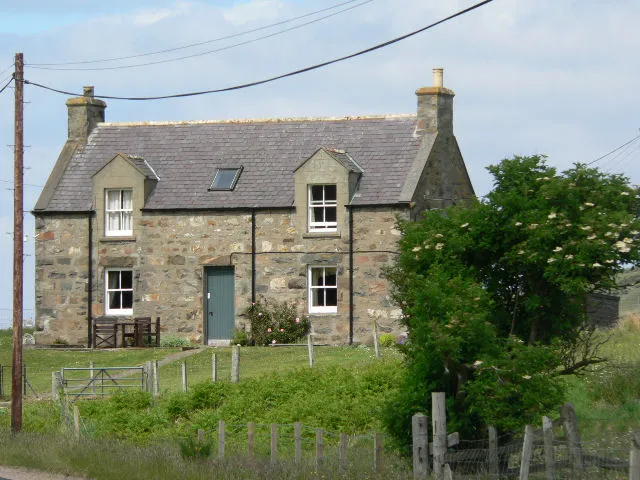
Photo: RH Dengate, CC BY-SA 2.0, via Wikimedia Commons
Built to Last, Built to Live: The Quiet Wisdom of Dunbeath's Working Cottages
Somewhere between the fourth energy bill of the year and another news cycle about loneliness, isolation, and the cost of everything, it's tempting to wonder whether we've simply forgotten something important about how to live. Not in a nostalgic, back-to-the-land way — but in a genuinely practical sense. Were there approaches to housing, community, and daily life that worked rather well, and that we quietly abandoned in pursuit of something that turned out to be less satisfying?
Dunbeath's traditional fishermen's cottages make a quiet argument that the answer is yes.
Reading the Buildings
The first thing you notice about Dunbeath's older cottages is how seriously they take the landscape. They're not placed arbitrarily. They sit low, turned slightly away from the worst of the Atlantic weather, built from the same stone that makes up the cliffs and the headland. From a distance, they look almost grown rather than constructed — as though the village emerged gradually from the ground rather than being imposed upon it.
This isn't aesthetics. It's engineering. The thick stone walls that make these buildings so visually distinctive are also extraordinarily effective at regulating temperature. They absorb heat slowly and release it slowly — passive thermal mass, in the language of modern sustainable architecture, though the builders of Dunbeath's cottages would have had no use for that phrase. They simply knew what worked.
The small windows, which occasionally frustrate visitors expecting picture-glass sea views, were sized precisely to balance light against heat retention. Every opening in the building was a calculated trade-off between what you wanted and what you could afford to lose. That discipline — the idea that a building should give you what you need rather than everything you might want — is a design philosophy that a lot of modern construction has conspicuously failed to apply.
What the Residents Know
Margaret, who has lived in the same cottage on the edge of Dunbeath for over forty years, is clear-eyed about what the building does and doesn't offer. "It's never been a cold house," she says, in a way that suggests she's aware how surprising that sounds to people who imagine Highland winters as uniformly brutal. "You learn to work with it. Keep the doors closed, use the range properly, don't fight it."
That relationship — working with the building rather than against it — comes up repeatedly when you talk to long-term residents. The cottages reward attention and punish neglect, which sounds like a burden until you realise that the same attentiveness tends to produce people who understand their homes in an unusually intimate way. They know which wall gets damp in a north-easterly. They know how to stack the fuel. They know when the building is telling them something.
In an era when the average British household has almost no relationship with its own infrastructure — where the boiler is a mysterious box that either works or doesn't — that kind of knowledge looks increasingly valuable.
The Community Logic
The physical layout of Dunbeath's older residential areas reflects a social logic that's worth examining. The cottages are close together — not uncomfortably so, but close enough that neighbours are genuinely proximate. You hear each other. You notice when something is wrong. You borrow things and return them and borrow them again.
This isn't accidental. Fishing communities depended on mutual support in ways that were entirely practical. When a boat went out, everyone had a stake in its return. When a family hit a hard season, the network around them absorbed some of the shock. The architecture encoded that interdependence — it made community the path of least resistance, rather than something you had to consciously seek out.
Robert, who grew up in Dunbeath and returned after twenty years working in Aberdeen, puts it directly: "In the city, I could go a fortnight without a proper conversation with anyone I knew. Here, that's not possible. The place won't let you disappear."
Britain is currently spending considerable money and energy trying to address what public health officials have taken to calling a loneliness epidemic. The design of Dunbeath's traditional streets didn't solve loneliness — it largely prevented it from taking hold in the first place.
Low Impact by Necessity, Low Impact by Choice
The environmental footprint of a traditional Highland fishing cottage was small not because its occupants were particularly virtuous but because excess was simply unavailable. You caught what you needed. You grew what you could. You repaired rather than replaced, because replacement was expensive and repair was a skill you already had.
The contemporary resonance of this is obvious, even if the specifics have changed. The principle — that a household should operate within its actual means rather than its theoretical capacity — is one that a significant portion of the UK is being pushed towards, willingly or otherwise, by rising costs and environmental pressure.
What Dunbeath's cottages demonstrate is that this kind of constraint isn't inherently miserable. The buildings are beautiful precisely because every decision in them was purposeful. There's no wasted space, no decorative gesture that doesn't also do something useful. That produces a clarity of form that expensive contemporary architecture often spends a great deal of money trying to replicate.
The Lesson Worth Taking Home
None of this is an argument for everyone to move to a stone cottage in Caithness, appealing as that might sound on a particularly grim Tuesday in February. It's an argument for paying attention to what these buildings got right — and asking whether those principles have any application in the houses most of us actually live in.
Smaller spaces used more thoughtfully. Buildings that respond to their climate rather than fighting it. Neighbourhoods designed for proximity rather than privacy. Repair cultures over replacement cultures. These aren't radical ideas. In Dunbeath, they're just the way things were built.
The cottages are still there. They're still working. And they're still, if you take the time to look at them properly, teaching anyone willing to pay attention.