Layers of Time: What Dunbeath's Ancient Ground Tells Us About Scotland's First Settlers
Layers of Time: What Dunbeath's Ancient Ground Tells Us About Scotland's First Settlers
There's a particular feeling you get walking the moorland above Dunbeath. The ground feels older than the hills, older than the wind coming off the Pentland Firth. That's not just poetic fancy — it's essentially true. Beneath the rough grass and waterlogged peat, the landscape has been quietly preserving human stories for five thousand years or more. Once you know what to look for, it becomes almost impossible to look away.
 Photo: Pentland Firth, via www.baxternature.com
Dunbeath sits at the southern edge of Caithness, a county that punches well above its weight when it comes to prehistoric remains. The combination of relatively low agricultural disturbance, acidic peat that preserves organic material, and a long tradition of local antiquarian interest means the ground here has given up extraordinary things — and almost certainly has more to offer still.
The Neolithic Foundations: When Farming First Came North
The story begins roughly five thousand years ago, when the first farming communities began pushing northwards through Scotland. These were people who had abandoned the purely nomadic life of their Mesolithic predecessors — they built permanent structures, tended animals, grew crops, and, crucially for us, buried their dead in ways that left lasting marks on the land.
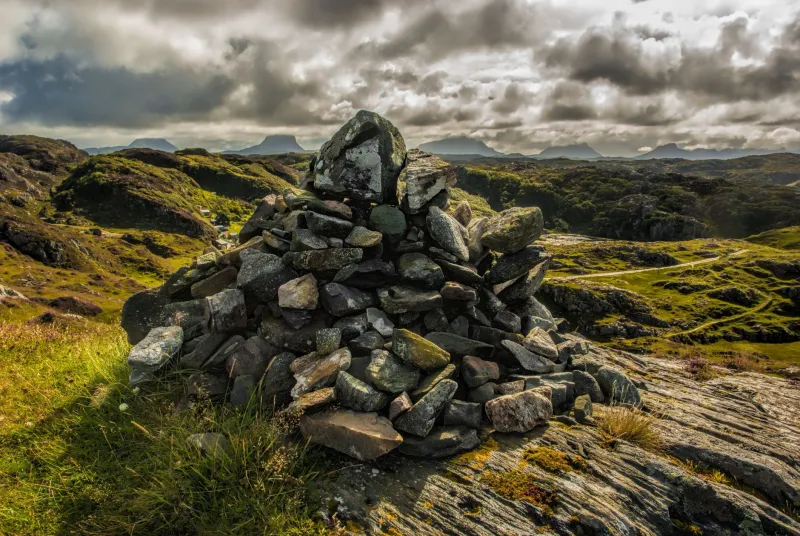
The most visible evidence of Neolithic activity in the Dunbeath area comes in the form of chambered cairns — those low, rounded mounds of stone that dot the moorland and hilltops of Caithness like punctuation marks in a very long sentence. These weren't simply graves. Archaeologists now understand them as communal monuments, places where the remains of ancestors were stored and revisited, possibly for generations. The act of building one was itself a statement: we belong here, this land is ours, and we intend to stay.
The effort involved in constructing these cairns — hauling and stacking thousands of tonnes of local flagstone without metal tools or wheeled transport — speaks to communities with considerable social organisation. These weren't scattered bands of survivors. They were settled people with a sense of permanence and purpose.
Bronze Age Ambitions: Reading the Ritual Landscape
Move forward a thousand years or so and the character of the landscape changes again. The Bronze Age communities who lived around Dunbeath between roughly 2000 and 700 BC left a different kind of mark — one that suggests a shift in how people related to their environment and to each other.
Round cairns, standing stones, and the remains of field systems all begin to appear during this period. The round cairns, typically covering individual burials rather than communal ones, hint at a growing emphasis on personal identity and status. Grave goods — bronze tools, pottery, occasional items of jewellery — tell us these were people who thought carefully about what the dead might need, or what their burial said about who they had been in life.
The standing stones are perhaps the most evocative remnants of this era. Scattered across the Caithness moorland, they remain deeply ambiguous — markers of territory, astronomical alignments, memorials, meeting points? Most likely a combination, shifting in meaning as generations passed. What they make absolutely clear is that Bronze Age communities were actively shaping and marking their landscape, turning the moorland into something that was simultaneously practical and symbolic.
For visitors walking the Dunbeath Strath, the sight of a lone standing stone on a hillside against a grey Highland sky is genuinely arresting. It has that quality of making five thousand years feel suddenly very short.
Iron Age Ingenuity: The Broch Builders of the North
By the Iron Age — roughly 700 BC onwards — something extraordinary was happening in northern Scotland. Communities here were constructing brochs: those remarkable dry-stone towers, unique to Scotland, that represent one of the most sophisticated architectural achievements of prehistoric Europe. Dunbeath Castle itself stands near the site of one such structure, and the wider landscape contains the remains of several more.
Brochs are genuinely puzzling. They were built without mortar, yet their double-walled construction and internal staircases demonstrate an engineering understanding that still impresses structural specialists. Some stood twelve metres high or more. Whether they were primarily defensive structures, high-status residences, or symbols of communal power — or all three at different times — remains a matter of active debate.
What they tell us unambiguously is that Iron Age communities in this part of Caithness had access to skilled labour, surplus resources, and the kind of social cohesion required to undertake major construction projects. These were not marginal people scratching a living at the edge of the known world. They were, by any reasonable measure, thriving.
The Landscape as Living Archive
What makes the Dunbeath area particularly special for anyone with an interest in prehistory is the way all these layers coexist. Walk a single ridge and you might pass a Neolithic cairn, a Bronze Age standing stone, and the earthwork remains of an Iron Age settlement within the space of an hour. The landscape doesn't present these things in museum cases with explanatory labels — it just offers them up, quietly, to anyone patient enough to look.
Local historians and members of the Highland Archaeological Society have done invaluable work in cataloguing and contextualising these remains, and their knowledge is genuinely worth seeking out. A conversation with someone who has spent decades walking this ground will give you more than any guidebook.
Visiting Responsibly
A word that matters: these sites are irreplaceable. Scotland's ancient monuments are protected by law, and for good reason — once disturbed, the archaeological context that makes them meaningful is gone forever. Walk around cairns rather than over them, leave stones where you find them, and if you spot something that looks significant and unrecorded, report it to the Highland Council's archaeology service rather than investigating it yourself.
The reward for that restraint is a landscape that will still be telling its stories long after we're gone — which is, when you think about it, exactly what the people who built these monuments intended.