Come in January: The Case for Choosing Dunbeath at Its Wildest and Most Honest
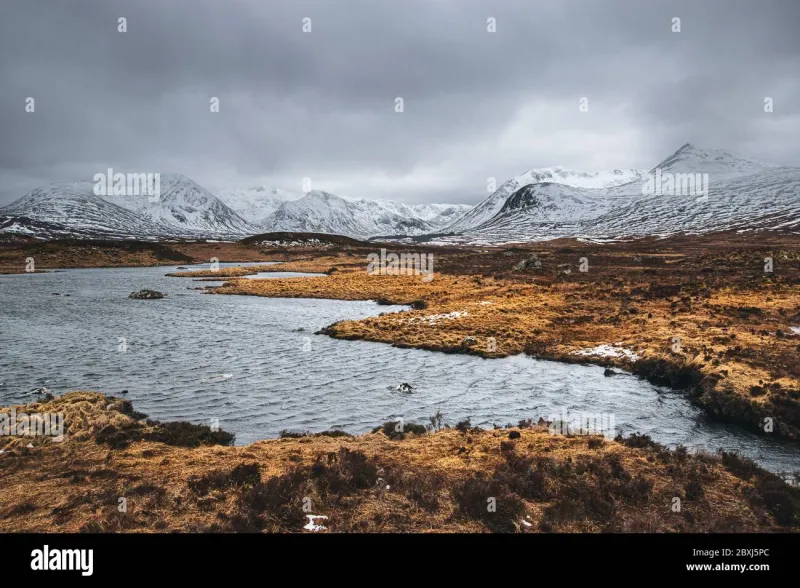
Photo: dramatic winter Scottish Highland coastline stormy sea grey sky, via c8.alamy.com
The light lasts about seven hours in Dunbeath in December. By January it's creeping back, but slowly, the way someone edges into a cold sea rather than diving. The sun, when it appears at all, stays low — a flat, amber thing that skims the horizon and throws shadows so long they seem to belong to a different geography entirely.
This is not the Dunbeath that appears in the photographs. It's better.
There's a version of Highland travel that's essentially a greatest-hits compilation: long evenings, heather in bloom, midges in the gloaming. It's real, and it's genuinely lovely, but it's also the version everyone else is having simultaneously, in the same layby, with the same flask of tea. Winter offers something categorically different — a Dunbeath that hasn't been curated for your comfort, that doesn't particularly care whether you're having a good time, and that rewards the people willing to meet it on its own terms.
The Village Without Its Visitors
Dunbeath in November is Dunbeath unguarded. The self-catering cottages are mostly empty. The car park at the heritage centre holds one or two vehicles where summer would pack it full. The harbour path is yours alone, unless you count the herring gulls, who have opinions about everything and share them freely.
This is not a sad emptiness. It's an honest one. You get to see the village as it actually is — a working community living its own life, not a backdrop arranged for passing travellers. Lights in cottage windows at three in the afternoon. Smoke from chimneys. The sound of a tractor somewhere up the brae. These are not picturesque details deployed for effect; they're simply what life looks like here in the dark months.
Alastair, who has lived in the village his entire life and fishes from the harbour whenever the weather allows, puts it plainly: "Winter's when you find out if you actually like a place. Because it's not trying to impress you."
What the Light Does
Photographers come to Dunbeath in summer for the long evenings and the golden hour that stretches on and on. In winter, the golden hour is the whole day — or very nearly. The low sun angle means that the cliff faces, the harbour walls, the old stone bridges across the burn, all catch light from angles impossible in summer. Textures emerge. Shadows deepen. The sea takes on colours that have no satisfactory names.
On clear days after a storm, when the air has been scoured clean and the light comes low from the south, the landscape around Dunbeath has a quality that's almost hallucinatory. Everything is sharp, immediate, vivid in a way that soft summer haze never quite achieves. You understand, on days like this, why painters and writers kept coming back to Caithness. The place has a visual intensity that the comfortable seasons slightly muffle.
And then there are the storms themselves. Standing at a safe distance on the cliff path while a North Sea gale drives spray forty feet up the rock face is one of the genuinely wild experiences available in the British Isles, and it's entirely free. It also, almost paradoxically, tends to produce a profound sense of calm once you're back inside with something warm in your hands. The contrast does something useful to your sense of proportion.
Solitude as a Practice
The wellness industry has spent considerable energy trying to sell solitude as a product. Silent retreats, digital detoxes, mindfulness weekends in converted barns — all of them are, at some level, attempts to manufacture what a winter week in Dunbeath delivers without any particular effort.
When there are no other visitors, when the days are short and the evenings are long and there's genuinely nothing to do except read, cook, walk, and think, something shifts. The internal noise that accumulates in ordinary life — the ambient anxiety, the background scroll, the low-grade sense of being perpetually behind — gradually loses its grip.
This doesn't happen immediately. The first couple of days can be genuinely uncomfortable for people accustomed to constant stimulation. The silence feels loud. The slowness feels like failure. But most visitors report that somewhere around day three, something gives way. The discomfort passes, and what's left is a quality of attention and presence that's increasingly hard to find anywhere else.
Susan, a teacher from Glasgow who has visited Dunbeath every January for the past five years, describes it as "the only time in the year when my brain actually goes quiet." She comes alone, walks every day regardless of weather, reads in the evenings, and goes to bed early. "It sounds bleak when I describe it to people," she admits. "But it's the thing I look forward to most all year."
The Practical Realities
Winter travel to Dunbeath requires a degree of preparation and flexibility that summer doesn't. The A9 north of Inverness can be challenging in ice or snow, and the village's exposed position means that coastal walks need to be timed around weather windows rather than personal preference. A good waterproof, layering, and boots with real grip are non-negotiable.
Accommodation options are more limited in winter, and it's worth booking ahead even for the quieter months — the people who know about winter Dunbeath tend to return to the same places year after year. A cottage with a wood-burning stove is not a luxury; it's the point.
But the logistics are manageable, and the reward is disproportionate. You get a landscape to yourself, a community that's genuinely pleased to see a visitor who's chosen to come in January, and the particular satisfaction of having made a trip that took a little more commitment than simply following the summer crowd north.
The Thing Nobody Tells You
Here is what the travel guides don't mention about winter in Dunbeath: it changes how you experience solitude, but it also changes how you experience connection. Because when there are only a handful of people around, every encounter carries more weight. A conversation with a local becomes a real exchange rather than a transaction. A shared nod on the harbour path feels like genuine acknowledgement.
You come back from winter Dunbeath not just rested but recalibrated. More patient. More present. Slightly better at being in a room with other people, paradoxically, because you've spent a week being properly alone.
January is waiting. It doesn't care if you're ready.