Feathers on the Edge: A Month-by-Month Guide to Dunbeath's Seabird Cliffs
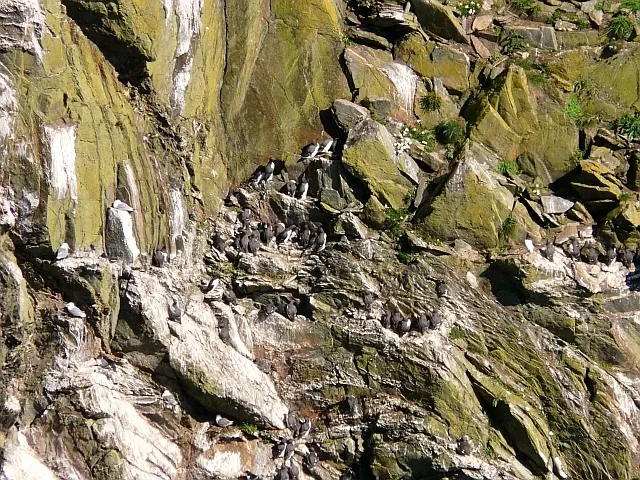
Photo: Rose and Trev Clough, CC BY-SA 2.0, via Wikimedia Commons
The cliffs that run south of Dunbeath don't advertise themselves. No visitor centre, no viewing platform, no helpful sign with an arrow. Just a footpath, a drop, and — once the season gets going — a wall of noise.
That's rather the point. Between roughly March and August, these ledges turn into one of the busiest addresses on the Caithness coast: guillemots and razorbills packed shoulder to shoulder in tiers, kittiwakes arguing over the narrowest real estate, fulmars muttering in the crevices. Then, by September, they're gone and the rock face is just rock again.
What follows is a year on those ledges — when to come, what you'll see, and how to watch without wrecking the place.
Late winter: the first ones back (January and February)
Birdwatching in January is mostly a matter of standing still and being cold. It's also when the first fulmars reappear on the cliff, often in filthy weather, riding the updraught in stiff-winged arcs and looking faintly put out by the whole arrangement.
Fulmars are worth the shiver. They're tubenoses — cousins of the albatross — and if you get a decent view you'll see the tube on top of the bill that lets them taste the air for fish. They aren't nesting yet. They're prospecting, reacquainting themselves with a ledge they may have used for twenty years.
Winter is also seal season. Grey seals pup along this coast in the back end of the year, and by February the adults are loafing on the skerries below the cliffs. Keep well back, keep quiet, and use the binoculars you remembered to bring.
Spring: the ledges fill up (March to May)
March is the turning point. Guillemots appear on the rock, standing in dense rows and sounding like a distant playground at breaktime. They don't bother building anything — one egg, laid straight onto a ledge, pear-shaped so it rolls in a tight circle rather than off the edge. That's the entire nest.
Razorbills arrive alongside them: fewer in number, smarter in appearance, always keen on a crevice. Shags nest lower down in the dark and the damp, and you'll often smell them before you see them.
By April the puffins are coming ashore. They raft up on the water in loose flocks through the day and only commute in during the early morning or late evening — which is why the person who came at noon swears there were no puffins, and the person who came at seven has three hundred photographs.
May is when things get serious. Kittiwakes plaster seaweed and grass onto the sheerest faces and call it a nest. Fulmars lay. The shore below is busy too: oystercatchers whistling on the rocks, eiders with their ducklings-in-waiting, shelduck out on the sand.
Summer: noise, chicks and jumplings (June and July)
This is peak season, and peak anxiety for anyone who actually cares about these birds.
Guillemot chicks leave the ledge long before they can properly fly. At around three weeks old they simply step off — the famous "jumpling" — and glide down to a father waiting on the sea, who then swims them out to open water. Watching it is genuinely alarming the first time.
Puffins in July are as easy to see as they'll ever be: bills full of sand eel, whirring back to burrows, largely indifferent to a respectful audience. Keep off the grassy banks at the cliff top, though. Those are burrow roofs, and a boot through one ends a chick's season.
Offshore, gannets work the water — big, pale, dagger-beaked birds folding into a dive from a height you can't quite believe. Treat them as commuters rather than residents; the birds you see here travel in from colonies well beyond Dunbeath.
Autumn: the slow emptying (August and September)
By the first week of August most puffins have gone, and it always feels abrupt. The guillemots and razorbills follow, the kittiwake chicks fledge, and the cliffs go from theatre to empty auditorium in about three weeks.
Still worth a walk, mind. Migrants move through the strath, waders work the shore, and the September light is the best of the year.
Winter: the cliff goes quiet (October to December)
Rough weather, big seas, no nesting birds to disturb. This is the honest time to walk the coast: purple sandpipers on the wet rocks, turnstones, eider, cormorants drying their wings like coats on a line. Otters are possible anywhere along the shore if you're early and quiet.
And by November the first fulmars are back on the ledges, sizing up another year.
Where to stand
The coastal path south of the village gives you the long view onto the cliff face without taking you near the edge. The harbour mouth at low tide is good for waders and close-up sea watching. If you want a full seabird city, Duncansby Head and Dunnet Head are both a straightforward day out, and Handa Island in summer is worth the run north.
Ground rules, briefly
Stay on the path and back from the edge — for your safety, and because a silhouette on the skyline lifts birds off nests. Keep low, keep quiet, keep dogs on a short lead. No drones, no recorded calls, and no "rescuing" chicks that are being watched by a parent from thirty feet away. If a bird starts alarm-calling, you're too close. Take the hint and back off.
The calendar, in the end, belongs to them. You're just lucky enough to be invited to watch.